
 A megapixel (MP or Mpx) is one million pixels, and is a term used not only for the number of pixels in an image, but to express the number of image sensor elements of digital cameras or the number of display elements of digital displays. For example, a camera with an array of 2048 × 1536 sensor elements is commonly said to have "3.1 megapixels" (2048 × 1536 = 3,145,728).
Digital cameras use photosensitive electronics, consisting of a large number of single sensor elements, each of which records a measured intensity level. These sensor elements are often called "pixels", even though they only record 1 channel (only red, or green, or blue) of the final color image.
Citing megapixels (MP) is a popular shorthand way to express the resolution of a digital camera in terms of how many millions of individual pixels (picture elements) are present in the image at time of capture.

Digital cameras use photosensitive electronics, consisting of a large number of single sensor elements, each of which records a measured intensity level. These sensor elements are often called "pixels", even though they only record 1 channel (only red, or green, or blue) of the final color image.
Citing megapixels (MP) is a popular shorthand way to express the resolution of a digital camera in terms of how many millions of individual pixels (picture elements) are present in the image at time of capture.
Take control of your picture-taking and watch your pictures dramatically improve. Become a picture director, not just a passive picture-taker. A picture director takes charge. A picture director picks the location: "Everybody go outside to the backyard." A picture director adds props: "Girls, put on your pink sunglasses." A picture director arranges people: "Now move in close, and lean toward the camera."


 Is your camera vertically challenged? It is if you never turn it sideways to take a vertical picture. All sorts of things look better in a vertical picture.
From a lighthouse near a cliff to the Eiffel Tower to your four-year-old niece jumping in a puddle. So next time out, make a conscious effort to turn your camera sideways and take some vertical pictures.
The number one flash mistake is taking pictures beyond the flash's range. Why is this a mistake? Because pictures taken beyond the maximum flash range will be too dark. For many cameras, the maximum flash range is less than fifteen feet—about five steps away.


If your subject is smaller than a car, take a step or two closer before taking the picture and zoom in on your subject. Your goal is to fill the picture area with the subject you are photographing. Up close you can reveal telling details, like a sprinkle of freckles or an arched eyebrow.
But don't get too close or your pictures will be blurry. The closest focusing distance for most cameras is about three feet, or about one step away from your camera. If you get closer than the closest focusing distance of your camera (see your manual to be sure), your pictures will be blurry.


But don't get too close or your pictures will be blurry. The closest focusing distance for most cameras is about three feet, or about one step away from your camera. If you get closer than the closest focusing distance of your camera (see your manual to be sure), your pictures will be blurry.


Direct eye contact can be as engaging in a picture as it is in real life. When taking a picture of someone, hold the camera at the person's eye level to unleash the power of those magnetic gazes and mesmerizing smiles. For children, that means stooping to their level. And your subject need not always stare at the camera. All by itself that eye level angle will create a personal and inviting feeling that pulls you into the picture.


Next Tip - Coming tomorrow… Don’t have patience? subscribe to RSS/Email Feed
Previous Tip - Lock Focus
Next Tip - Coming tomorrow… Don’t have patience? subscribe to RSS/Email Feed
Previous Tip - Lock Focus

If your subject is not in the center of the picture, you need to lock the focus to create a sharp picture. Most auto-focus cameras focus on whatever is in the center of the picture. But to improve pictures, you will often want to move the subject away from the center of the picture. If you don't want a blurred picture, you'll need to first lock the focus with the subject in the middle and then recompose the picture so the subject is away from the middle.
Usually you can lock the focus in three steps. First, center the subject and press and hold the shutter button halfway down. Second, reposition your camera (while still holding the shutter button) so the subject is away from the center. And third, finish by pressing the shutter button all the way down to take the picture.
Next Tip - Look in Eyes
Previous Tip - watch the light
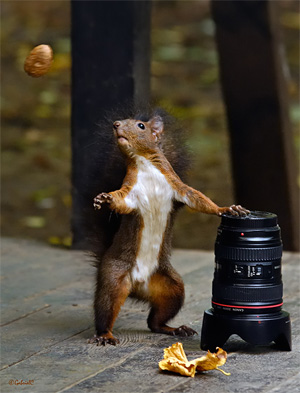
So you bought yourself a SLR camera. What now? You obviously need more lenses.
To find out which lenses to suit your specific use is not always easy. There are several abbreviations and specifications you need to find out, and things are not better by the fact that different manufacturers use completely different abbreviations for exactly the same properties.
Below I take a review of the important features you can find on a lens, and how the different manufacturers label them.
Please note that some specs may be slightly simplified to make the article shorter and more readable. For example, the EC designation marked on Canon lenses indicates that it has an autofocus (Electronic Focus), but also indicates which frame the lens uses.
Read the article by Morris Scjomin


