
 A megapixel (MP or Mpx) is one million pixels, and is a term used not only for the number of pixels in an image, but to express the number of image sensor elements of digital cameras or the number of display elements of digital displays. For example, a camera with an array of 2048 × 1536 sensor elements is commonly said to have "3.1 megapixels" (2048 × 1536 = 3,145,728).
Digital cameras use photosensitive electronics, consisting of a large number of single sensor elements, each of which records a measured intensity level. These sensor elements are often called "pixels", even though they only record 1 channel (only red, or green, or blue) of the final color image.
Citing megapixels (MP) is a popular shorthand way to express the resolution of a digital camera in terms of how many millions of individual pixels (picture elements) are present in the image at time of capture.

Citing megapixels (MP) is a popular shorthand way to express the resolution of a digital camera in terms of how many millions of individual pixels (picture elements) are present in the image at time of capture.

The focal length of a lens refers to the actual length of the lens from a point inside its front lens element to the point where it comes to focus -- in our case, that is on the camera sensor -- when the lens is focused at infinity. Modern optical systems and zooms can make this calculation more exacting, but this definition is sufficient to understanding the elementary difference between lenses and how to use them creatively. Focal length is typically expressed in millimeters for modern DSLR lenses.
What we call a "normal" lens is one where the focal length is approximately equal to the diagonal of the sensor plane. On a full-frame (35mm) sensor that would be a 50mm lens. On the smaller APS sized sensor that would be a 35mm lens. All other focal length categories are given relative to what is "normal".
For instance, a wide angle lens is one that is wider that a normal lens, while a telephoto lens is longer than a normal lens.
Wide angle lenses take in a larger visual area that makes them most suitable for wide landscapes, while telephotos act more like telescopes for close-up viewing of distant subjects. These are the obvious, practical reasons for selecting one focal length over another. More importantly, however, are the creative characteristics each focal length has.
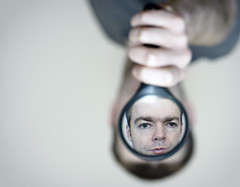
Well i guess you got some basic idea about focal length. lets have some break till we comeback with more detailed post about focal length. meanwhile i recommend you to go through some of the articles recommended below (external links of course).
- Photography tipsUnderstanding Focal Length (nikonusa.com)
- Available Types of Camera Lens (richardhoffkins.wordpress.com)
- Why Prime Lenses? (photofocus.com)
- Buying Guide: Best budget telephoto zoom Nikon lens (techradar.com)

 Welcome back guys…. If you have been following my blog from lately, you might be already aware about my craziness in photography. Even though my blog contains contents from all topics, photography is one major Topic in those.

 Is your camera vertically challenged? It is if you never turn it sideways to take a vertical picture. All sorts of things look better in a vertical picture.
From a lighthouse near a cliff to the Eiffel Tower to your four-year-old niece jumping in a puddle. So next time out, make a conscious effort to turn your camera sideways and take some vertical pictures.


But don't get too close or your pictures will be blurry. The closest focusing distance for most cameras is about three feet, or about one step away from your camera. If you get closer than the closest focusing distance of your camera (see your manual to be sure), your pictures will be blurry.


Next Tip - Coming tomorrow… Don’t have patience? subscribe to RSS/Email Feed
Previous Tip - Lock Focus

If your subject is not in the center of the picture, you need to lock the focus to create a sharp picture. Most auto-focus cameras focus on whatever is in the center of the picture. But to improve pictures, you will often want to move the subject away from the center of the picture. If you don't want a blurred picture, you'll need to first lock the focus with the subject in the middle and then recompose the picture so the subject is away from the middle.
Usually you can lock the focus in three steps. First, center the subject and press and hold the shutter button halfway down. Second, reposition your camera (while still holding the shutter button) so the subject is away from the center. And third, finish by pressing the shutter button all the way down to take the picture.
Next Tip - Look in Eyes
Previous Tip - watch the light
You'll need to lock the focus if you have an auto-focus camera because most of them focus on whatever is in the centre of the viewfinder.


Previous Tip>
Technorati Tags: Move,Centre,performer,life,Start,Imagine,grid,intersections,auto,viewfinder WordPress Tags: Move,Centre,performer,life,Start,Imagine,grid,intersections,auto,viewfinder
Blogger Labels: Move,Centre,performer,life,Start,Imagine,grid,intersections,auto,viewfinder
Bright sun can create unattractive deep facial shadows. Eliminate the shadows by using your flash to lighten the face. When taking people pictures on sunny days, turn your flash on. You may have a choice of fill-flash mode or full-flash mode. If the person is within five feet, use the fill-flash mode; beyond five feet, the full-power mode may be required. With a digital camera, use the picture display panel to review the results.
On cloudy days, use the camera's fill-flash mode if it has one. The flash will brighten up people's faces and make them stand out. Also take a picture without the flash, because the soft light of overcast days sometimes gives quite pleasing results by itself.


Next Tip> 10 tips for better clicks : Move it from the middle (Tip 2)
Technorati Tags: Read,facial,Eliminate,mode,person,feet,panel,Also,patience,Email,five,camera
Windows Live Tags: Read,facial,Eliminate,mode,person,feet,panel,Also,patience,Email,five,camera
Word Press Tags: Read,facial,Eliminate,mode,person,feet,panel,Also,patience,Email,five,camera
Blogger Labels: Read,facial,Eliminate,mode,person,feet,panel,Also,patience,Email,five,camera
Look At The Food They Bought For One Week and The Number Of Persons In The Family
GERMANY:
The Melander family of Bargteheide - 2 adults , 2 teenagers
Food expenditure for one week: 375.39 Euros or $500.07 
UNITED STATES:
The Revis family of North Carolina - 2 adults , 2 teenagers
Food expenditure for one week: $341.98 
JAPAN:
The Ukita family of Kodaira City - 2 adults , 2 teenagers
Food expenditure for one week: 37 , 699 Yen or $317.25 
ITALY:
The Manzo family of Sicily - 2 adults , 3 kids
Food expenditure for one week: 214.36 Euros or $260.11 
MEXICO:
The Casales family of Cuernavaca - 2 adults , 3 kids
Food expenditure for one week: 1 , 862.78 Mexican Pesos or $189.09 
POLAND:
The Sobczynscy family of Konstancin-Jeziorna - 4 adults , 1 teenager
Food expenditure for one week: 582.48 Zlotys or $151.27 
EGYPT:
The Ahmed family of Cairo - 7 adults , 5 kids
Food expenditure for one week: 387.85 Egyptian Pounds or $68.53 
ECUADOR:
The Ayme family of Tingo - 4 adults , 5 teenagers
Food expenditure for one week: $31.55 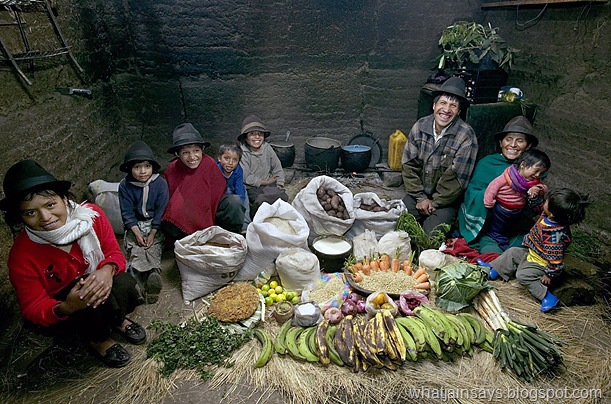
BHUTAN:
The Namgay family of Shingkhey Village - 7 adults , 6 kids
Food expenditure for one week: 224.93 ngultrum or $5.03 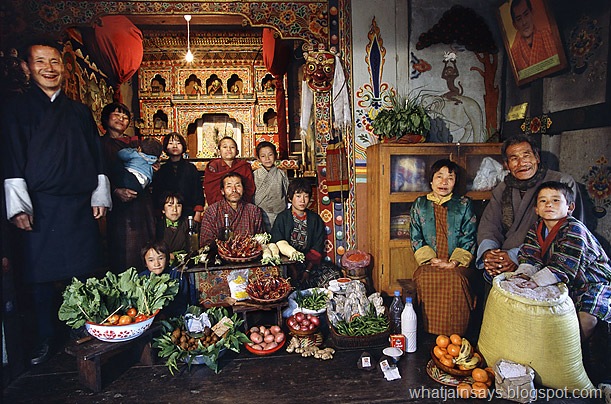
CHAD:
The Aboubakar family of Breidjing Camp - 3 adults , 3 kids
Food expenditure for one week: 685 CFA Francs or $1.23


The golden pheasant of Asia is a brilliantly colored game bird. It is native to forests in mountainous areas of western China but feral populations have been established in the United Kingdom and elsewhere.
2. Birds of Paradise (Paradisaeidae)
The greater bird of paradise found in New Guinea has elongated flank feathers that form ornamental plumes. Bird of Paradise is a tropical bird known for the brilliant plumage of the male. They live mostly in New Guinea and neighbouring islands. The brilliantly colored feathers of the male were once widely sought as decorations for women's hat.

3. Hyacinth Macaw (Anodorhynchus hyacinthinus)

Hyacinth Macaws are native to central and eastern South America . It is the largest macaw and the largest flying parrot species in the world, though the flightless Kakapo of New Zealand can outweigh it at up to 3.5kg. In terms of length it is larger than any other species of parrot. Their popularity as pets has taken a heavy toll on their population in the wild. Birds in captivity fetch a price of around $9,000-$12,000 US.
4. Flamingo (Phoenicopteridae)

Flamingos are found in both the Western Hemisphere and Eastern Hemisphere . Flamingos frequently stand on one leg. The reason for this behavior is not fully known. Flamingo tongues were considered a delicacy in Ancient Rome. Also, Andean miners have killed flamingos for their fat, believed to be a cure for tuberculosis
5. Scarlet Tanager (Piranga olivacea)

The scarlet tanager is a medium-sized American songbird. Adult males are bright red with black wings and tail; females are yellowish on the underpants and olive on top, with olive-brown wings and tail.
6. Northern Oriole (Icterus galbula)

Northern oriole is formerly known as Baltimore oriole in the east and Bullock's oriole in the west. This is a small icterid blackbird which is 18 cm long and weighs 34 g. It is one of the brightest local birds and has a voice to match its distinctive plumage.
7. Mountain Bluebird (Sialia currucoides)

The bluebirds are medium-sized, mostly insectivorous or omnivorous birds in the genus Sialia of the thrush family Turdidae. These are attractive birds with blue, or blue and red, plumage. Female birds are less brightly colored than males.
8. Northern Cardinal (Cardinalis cardinalis)

The northern cardinal is also known as the Redbird and the Virginia nightingale. The Northern Cardinal is a mid-sized songbird with a body length of 21-23 cm (8.3 to 9 inches). It has a distinctive crest on the head and a mask on the face which is black in the male and gray in the female.
9. American Goldfinch (Carduelis tristis)
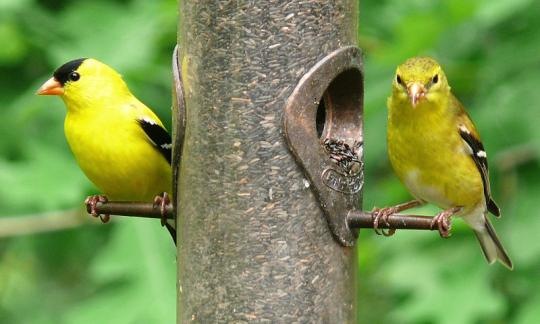
The American goldfinch is also known as the Eastern Goldfinch and Wild Canary. The male displays brightly colored plumage during the breeding season to attract a mate. The courtship rituals of the American Goldfinch include aerial manoeuvres and singing by males.
10. Wood Duck (Aix sponsa)

The Wood Duck or Carolina Duck is a medium-sized perching duck. A typical adult is about 19 inches in length with an average wingspan of 29 inches. The adult male has distinctive multi-colored iridescent plumage and red eyes. The female, less colorful, has a white eye-ring and a whitish throat.
11. Kingfisher (Halcyonidae)

There are about 90 species of kingfisher. All have large heads, long, sharp, pointed bills, short legs, and stubby tails. They are found throughout the world.
12. Green Wing Macaw Parrot (Ara chloroptera)

The superficially similar Scarlet Macaw has no eye lines and a yellow bar on each wing. Some macaw owners and experts call the Green-winged Macaw the "gentle giant", as it is larger in size than the Scarlet Macaw and Blue-and-yellow Macaw, but have a more docile, sweet nature which often makes it a more desirable pet or companion parrot.
13. Troupial (Icterus icterus)

Troupial or trupial is the national bird of Venezuela . The Troupial is fairly large in size, with a long tail and a bulky bill. It has a black head and upper breast. Troupials are obligate nest pirates, meaning they make no nest of their own, and are thus required to steal or occupy a vacant nest in order to survive. Troupials are capable of violent attacks against native nesters, and once they possess these territories they defend them fiercely against intruders. They may even ingest the eggs or young hatchlings of a newly acquired nest.
14. Blue Throated Bee-Eater (Merops viridis)
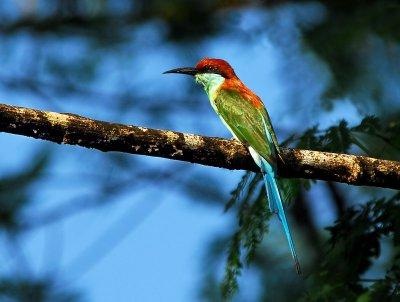
The bee-eaters are a group of near passerine birds in the family Meropidae. They are characterized by richly colored plumage, slender bodies and usually elongated central tail feathers. It is a species of bird in the Meropidae family. It is found in Hong Kong , Taiwan , China and countries in Southeast Asia .
15. Painted Bunting (Passerina ciris)

The male Painted Bunting is often described as the most beautiful bird in North America . Its beautiful colors, dark blue head, green back, red rump and underparts, make it easy to identify.
16. Keel-billed Toucans (Ramphastos sulfuratus)
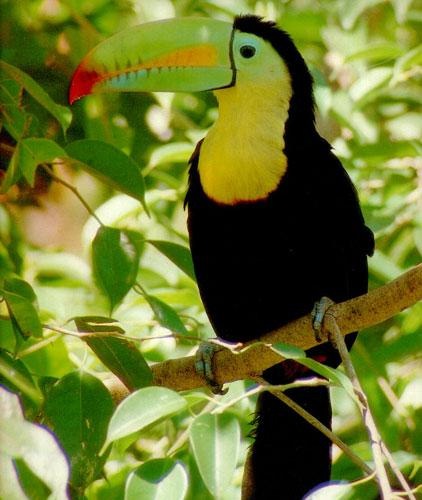
This bird is the national bird of Belize . Toucans belong to family Ramphastidae They are brightly marked and have large, colorful bills. It is also known as Sulfur-breasted Toucan, Rainbow-billed Toucan, and colloquially "the bill bird" (though this might refer to any toucan). It is a colorful South American bird with a large bill.
17. Rainbow Lorikeet (Trichoglossus haematodus)

The Rainbow Lorikeet is very colorful as its name suggests. Almost every color of the rainbow is found on the feathers of the rainbow lorikeet. Captive lorikeets have a long lifespan, often in excess of 20 years.
18. Scarlet Macaw (Ara macao )

The Scarlet Macaw is a large, colorful parrot. It is native to humid evergreen forests in the American tropics, from extreme eastern Mexico locally to Amazonian Peru and Brazil . It's the national bird of Honduras .
19. Stork-billed Kingfisher (Pelargopsis capensis)

This is a stork-billed kingfisher from South India . Stork-billed kingfisher is a tree kingfisher which is widely but sparsely distributed in tropical south Asia from India and Sri Lanka to Indonesia .
20. Peafowl or Peacock (Pavo)

Peafowl, a large bird of the pheasant family, is among the most colorful of birds. Asian peacocks have long been domesticated. The males are noted for their display of brilliant plumage. To attract attention, during courtship and at other times, the male lifts the train and spreads it out in a fan that arches over the bird's back and touches the ground on either side.


