
A man found a cocoon of a butterfly. One day a small opening appeared; he sat and watched the butterfly for several hours as it struggled to force its body through that little hole. Then it seemed to stop making any progress. It appeared as if it had gone as far as it could and it could go no farther.
Then the man decided to help the butterfly, so he took a pair of scissors and snipped off the remaining bit of the cocoon. The butterfly then emerged easily. But it had a swollen body and small, shriveled wings.
The man continued to watch the butterfly because he expected that, at any moment, the wings would enlarge and expand to be able to support the body, which would contract in time.
Neither happened! In fact, the butterfly spent the rest of its life crawling around with a swollen body and shriveled wings. It never was able to fly.
What the man in his kindness and haste did not understand was that the restricting cocoon and the struggle required for the butterfly to get through the tiny opening were God's way of forcing fluid from the body of the butterfly into its wings so that it would be ready for flight once it achieved its freedom from the cocoon.
Sometimes struggles are exactly what we need in our life. If God allowed us to go through our life without any obstacles, it would cripple us. We would not be as strong as what we could have been.
Going to church every Sunday ............. ..
Going to Mosque every Friday ...............
Going to Temple every Saturday .......... ...

BAPS Swaminarayan AkshardhamBAPS Swaminarayan Akshardham is a 100-acre Hindu temple complex in New Delhi , India . It aims to showcase Hinduism's ancient art, culture and spiritual heritage.
Since its opening in November 2005, Swaminarayan Akshardham has become a popular landmark of India's cultural and religious landscape, attracting more than five million visitors a year. It featured in the 2009 edition of the Guinness World Records book for being the largest Hindu temple in the world.
Lotus garden
Over 60 acres of the complex comprise various forms of landscaping. One part is the Lotus Garden , a lotus-shaped sunken garden with messages from great world thinkers sharing their faith in God and humanity.


Largest Hindu temple in the world
The central feature of the complex is the ornately hand-carved stone temple, or mandir. Built according to ancient Vedic texts, and measuring 356 ft (109 m) long, 316 ft (96 m) wide and 141 ft (43 m) high, it is the world's largest comprehensive Hindu temple.
It was built within five years by 11,000 artisans and volunteers of BAPS Swaminarayan Sanstha, an international socio-religious organisation.

Exterior carvings
The outer wall of the temple is profusely covered with 200 stone figures of India's sages and intricate depictions of nature.

Temple sanctum
Enshrined in the temple's inner sanctum is an 11 ft.-high gilded murti (sacred image) of Bhagwan Swaminarayan, the deity to whom the temple and complex are dedicated. Other images include those of popular Hindu deities and spiritual leaders of the Swaminarayan tradition.

Interior carvings
The temple is a fusion of pink sandstone on the outside and white marble on the inside, but with no structural steel used anywhere. The interior is filled with 234 ornately carved pillars, 9 ornate domes, and intricately designed ceilings. In total, there are more than 20,000 carved figures.

Elephant plinth
The temple stands on a 1,070 ft.-long plinth of 148 full-sized elephants carved entirely from stone. Together, they weigh 3,000 tonnes.


Stone colonnade
The temple and its surrounding area are garlanded by a 3,000 ft (214 m)-long two-tiered stone colonnade. It features 1,152 pillars, 145 windows and 154 cupolas.

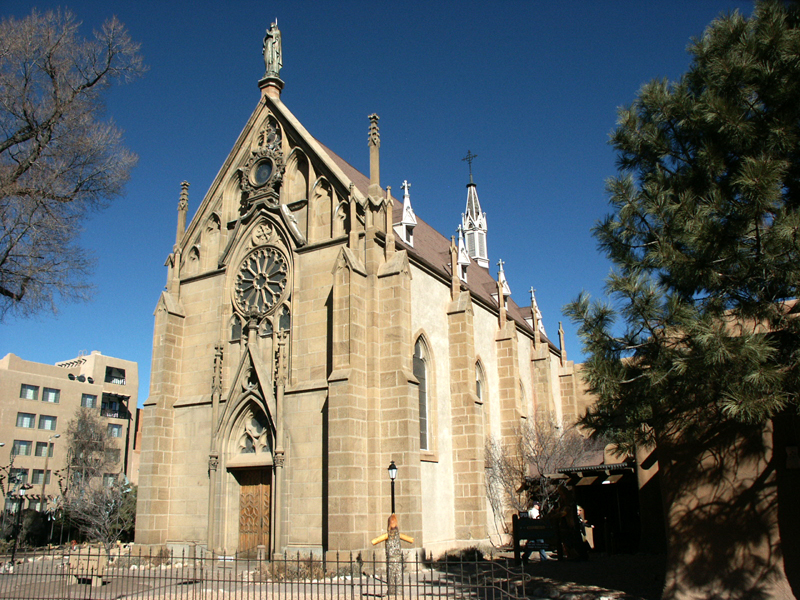
In the city of Santa Fé, in New Mexico, USA a mystery of over 130 years old exist. It attracts around 250 thousand visitors every year.
Point of attention : Loretto Chapel
The construction of the chapel was commisoned towards the end 19th century by Jean-Baptiste Lamy, the Bishop of the Santa Fe Archdiocese. The convent chapel was to be named Our Lady of Light Chapel, which would be in the care of the Sisters of Loretto. The chapel was designed by French architect Antoine Mouly in the Gothic Revival style, complete with spires, buttresses, and stained glass windows imported from France. Although it was built on a much smaller scale, the chapel bears an obvious resemblance to the Sainte-Chapelle in Paris.
No!. This is not the mystery..
What makes this chapel different from all others is that the subject of the supposed miracle that took place in it is a Staircase. When the chappel was ready, the nuns found that there was no staircase built to take them to the choir loft. The architect died suddenly and due to the chapel's small size, building a standard staircase would have been too large for the chapel..
The reputed story continues as follows..
The nuns prayed for St. Joseph's intercession for nine straight days. On the day after their novena ended a shabby looking stranger appeared at their door. He told the nuns he would build them a staircase but that he needed total privacy and locked himself in the chapel for three months. He used a small number of primitive tools including a square, a saw and some warm water and constructed a spiral staircase entirely of non-native wood. The identity of the carpenter is not known for as soon as the staircase was finally finished he was gone. Many witnesses, upon seeing the staircase, feel it was a miraculous occurrence.
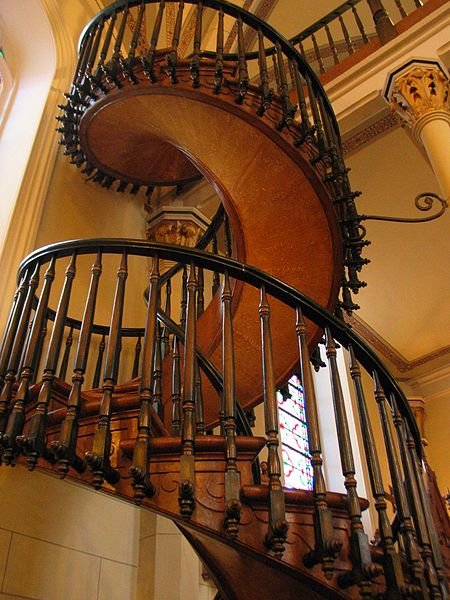 The staircase thus built, is an impressive work of carpentry. It ascends twenty feet, making two complete revolutions up to the choir loft without the use of nails or apparent center support. It has been surmised that the central spiral of the staircase is narrow enough to serve as a central beam. Nonetheless there was no attachment unto any wall or pole in the original stairway, although 10 years later a railing was added and the outer spiral was fastened to an adjacent pillar. Instead of metal nails, the staircase was constructed using dowels or wooden pegs. The wood for the staircase cannot be found anywhere in the region.
The stairs had 33 steps, the age of Jesus when he died...
The mystery had never been satisfactorily solved as to who the carpenter was or where he got his lumber, since there were no reports of anyone seeing lumber delivered or even seeing the man come and go while the construction was being done. Since he left before the Mother Superior could pay him, the Sisters of Loretto offered a reward for the identity of the man, but it was never claimed..
For Further Reading..  Title:“Loretto: The Sisters and Their Santa Fe Chapel (2002: Museum of New Mexico Press)
Author: Mary Jean Straw Cook
$22.50
Buy it from Amazon here


