

The golden pheasant of Asia is a brilliantly colored game bird. It is native to forests in mountainous areas of western China but feral populations have been established in the United Kingdom and elsewhere.
2. Birds of Paradise (Paradisaeidae)
The greater bird of paradise found in New Guinea has elongated flank feathers that form ornamental plumes. Bird of Paradise is a tropical bird known for the brilliant plumage of the male. They live mostly in New Guinea and neighbouring islands. The brilliantly colored feathers of the male were once widely sought as decorations for women's hat.

3. Hyacinth Macaw (Anodorhynchus hyacinthinus)

Hyacinth Macaws are native to central and eastern South America . It is the largest macaw and the largest flying parrot species in the world, though the flightless Kakapo of New Zealand can outweigh it at up to 3.5kg. In terms of length it is larger than any other species of parrot. Their popularity as pets has taken a heavy toll on their population in the wild. Birds in captivity fetch a price of around $9,000-$12,000 US.
4. Flamingo (Phoenicopteridae)

Flamingos are found in both the Western Hemisphere and Eastern Hemisphere . Flamingos frequently stand on one leg. The reason for this behavior is not fully known. Flamingo tongues were considered a delicacy in Ancient Rome. Also, Andean miners have killed flamingos for their fat, believed to be a cure for tuberculosis
5. Scarlet Tanager (Piranga olivacea)

The scarlet tanager is a medium-sized American songbird. Adult males are bright red with black wings and tail; females are yellowish on the underpants and olive on top, with olive-brown wings and tail.
6. Northern Oriole (Icterus galbula)

Northern oriole is formerly known as Baltimore oriole in the east and Bullock's oriole in the west. This is a small icterid blackbird which is 18 cm long and weighs 34 g. It is one of the brightest local birds and has a voice to match its distinctive plumage.
7. Mountain Bluebird (Sialia currucoides)

The bluebirds are medium-sized, mostly insectivorous or omnivorous birds in the genus Sialia of the thrush family Turdidae. These are attractive birds with blue, or blue and red, plumage. Female birds are less brightly colored than males.
8. Northern Cardinal (Cardinalis cardinalis)

The northern cardinal is also known as the Redbird and the Virginia nightingale. The Northern Cardinal is a mid-sized songbird with a body length of 21-23 cm (8.3 to 9 inches). It has a distinctive crest on the head and a mask on the face which is black in the male and gray in the female.
9. American Goldfinch (Carduelis tristis)
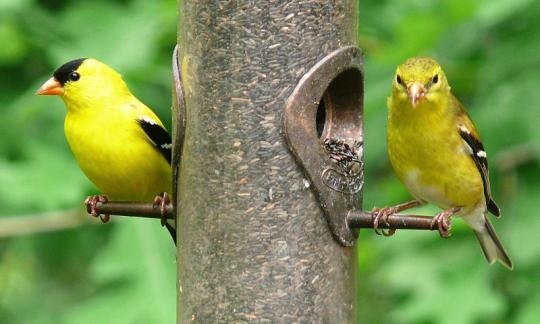
The American goldfinch is also known as the Eastern Goldfinch and Wild Canary. The male displays brightly colored plumage during the breeding season to attract a mate. The courtship rituals of the American Goldfinch include aerial manoeuvres and singing by males.
10. Wood Duck (Aix sponsa)

The Wood Duck or Carolina Duck is a medium-sized perching duck. A typical adult is about 19 inches in length with an average wingspan of 29 inches. The adult male has distinctive multi-colored iridescent plumage and red eyes. The female, less colorful, has a white eye-ring and a whitish throat.
11. Kingfisher (Halcyonidae)

There are about 90 species of kingfisher. All have large heads, long, sharp, pointed bills, short legs, and stubby tails. They are found throughout the world.
12. Green Wing Macaw Parrot (Ara chloroptera)

The superficially similar Scarlet Macaw has no eye lines and a yellow bar on each wing. Some macaw owners and experts call the Green-winged Macaw the "gentle giant", as it is larger in size than the Scarlet Macaw and Blue-and-yellow Macaw, but have a more docile, sweet nature which often makes it a more desirable pet or companion parrot.
13. Troupial (Icterus icterus)

Troupial or trupial is the national bird of Venezuela . The Troupial is fairly large in size, with a long tail and a bulky bill. It has a black head and upper breast. Troupials are obligate nest pirates, meaning they make no nest of their own, and are thus required to steal or occupy a vacant nest in order to survive. Troupials are capable of violent attacks against native nesters, and once they possess these territories they defend them fiercely against intruders. They may even ingest the eggs or young hatchlings of a newly acquired nest.
14. Blue Throated Bee-Eater (Merops viridis)
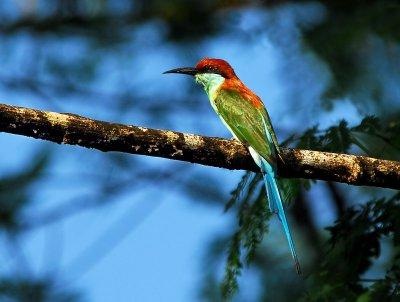
The bee-eaters are a group of near passerine birds in the family Meropidae. They are characterized by richly colored plumage, slender bodies and usually elongated central tail feathers. It is a species of bird in the Meropidae family. It is found in Hong Kong , Taiwan , China and countries in Southeast Asia .
15. Painted Bunting (Passerina ciris)

The male Painted Bunting is often described as the most beautiful bird in North America . Its beautiful colors, dark blue head, green back, red rump and underparts, make it easy to identify.
16. Keel-billed Toucans (Ramphastos sulfuratus)
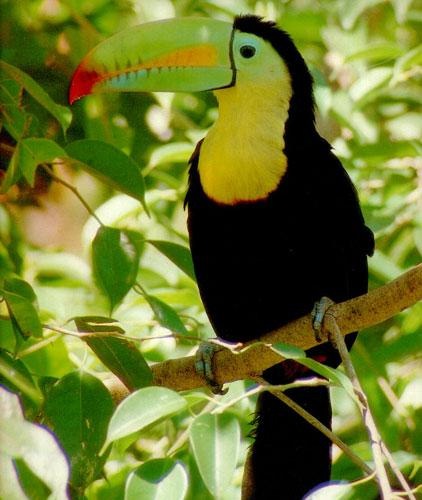
This bird is the national bird of Belize . Toucans belong to family Ramphastidae They are brightly marked and have large, colorful bills. It is also known as Sulfur-breasted Toucan, Rainbow-billed Toucan, and colloquially "the bill bird" (though this might refer to any toucan). It is a colorful South American bird with a large bill.
17. Rainbow Lorikeet (Trichoglossus haematodus)

The Rainbow Lorikeet is very colorful as its name suggests. Almost every color of the rainbow is found on the feathers of the rainbow lorikeet. Captive lorikeets have a long lifespan, often in excess of 20 years.
18. Scarlet Macaw (Ara macao )

The Scarlet Macaw is a large, colorful parrot. It is native to humid evergreen forests in the American tropics, from extreme eastern Mexico locally to Amazonian Peru and Brazil . It's the national bird of Honduras .
19. Stork-billed Kingfisher (Pelargopsis capensis)

This is a stork-billed kingfisher from South India . Stork-billed kingfisher is a tree kingfisher which is widely but sparsely distributed in tropical south Asia from India and Sri Lanka to Indonesia .
20. Peafowl or Peacock (Pavo)

Peafowl, a large bird of the pheasant family, is among the most colorful of birds. Asian peacocks have long been domesticated. The males are noted for their display of brilliant plumage. To attract attention, during courtship and at other times, the male lifts the train and spreads it out in a fan that arches over the bird's back and touches the ground on either side.
A group of frogs were travelling through the woods, and two of them fell into a deep pit. When the other frogs saw how deep the pit was, they told the two frogs that they were as good as dead. The two frogs ignored the comments and tried to jump up out of the pit with all their might. The other frogs kept telling them to stop, that they were as good as dead. Finally, one of the frogs took heed to what the other frogs were saying and gave up. He fell down and died.
The other frog continued to jump as hard as he could. Once again, the crowd of frogs yelled at him to stop the pain and just die. He jumped even harder and finally made it out. When he got out, the other frogs said, "Did you not hear us?" The frog explained to them that he was deaf. He thought they were encouraging him the entire time.
This story teaches two lessons:
1. There is power of life and death in the tongue. An encouraging word to someone who is down can lift them up and help them make it through the day.
2. A destructive word to someone who is down can be what it takes to kill them.
Be careful of what you say. Speak life to those who cross your path. The power of words... it is sometimes hard to understand that an encouraging word can go such a long way. Anyone can speak words that tend to rob another of the spirit to continue in difficult times. Special is the individual who will take the time to encourage another.
Essay "Indian Cow"
You'll forget your English by the time you finish reading this. This is a true essay written by a Bihari candidate (Mahesh Pandey) at the UPSC Examinations. The candidate has written an essay on the Indian cow:
INDIAN COW

HE IS THE COW. "The cow is a successful animal.
Also he is 4 footed, And because he is female, he
give milks, [ but will do so when he is got
child.] He is same like-God, sacred to Hindus and
useful to man. But he has got four legs together.
Two are forward and two are afterwards. His whole
body can be utilised for use. More so the milk.
Milk comes from 4 taps attached to his basement. [
horses dont have any such attachment]
What can it do? Various ghee, butter, cream, curd,
why and the condensed milk and so forth. Also he
is useful to cobbler, watermans and mankind
generally. His motion is slow only because he is
of lazy species, Also his other motion.. gober] is
much useful to trees, plants as well as for making
flat cakes[like Pizza] , in hand and drying in the
sun.
Cow is the only animal that extricates his feeding
after eating. Then afterwards she chew with his
teeth whom are situated in the inside of the
mouth. He is incessantly in the meadows in the
grass. His only attacking and defending organ is
the horns, specially so when he is got child. This
is done by knowing his head whereby he causes the
weapons to be paralleled to the ground of the
earth and instantly proceed with great velocity
forwards. He has got tails also, situated in the
backyard, but not like similar animals. It has
hairs on the other end of the other side. This is
done to frighten away the flies which alight on
his cohesive body hereupon he gives hit with it.
The palms of his feet are soft unto the touch. So
the grasses head is not crushed. At night time
have poses by looking down on the ground and he
shouts . His eyes and nose are like his other
relatives. This is the cow.......
This is a real incident and the “fortunately” the guy had passed the exam (only god knows how!!)


